

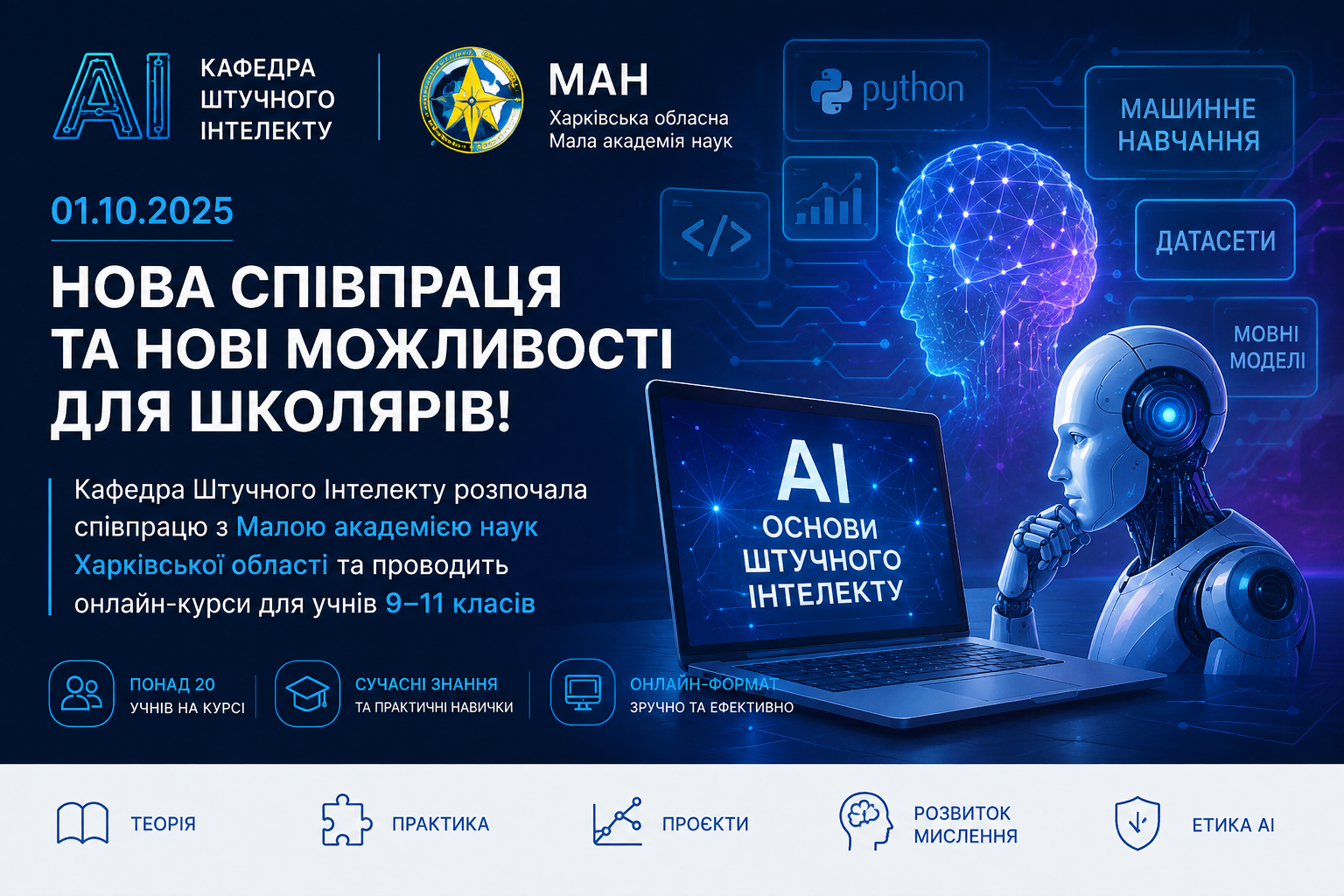
The Artificial Intelligence Department has begun cooperation with the Junior Academy of Sciences of Kharkiv Region
3 October 2025
On October 1, 2025, the Artificial Intelligence Department began cooperation with the Municipal Institution “Kharkiv Regional Junior Academy of Sciences of the Kharkiv Regional Council.” As part of this cooperation, online classes have started for students in grades 9–11 under the extracurricular education program in the research and experimental field, “Fundamentals of Artificial Intelligence.”
The authors of the curriculum are O. Yu. Dzhidzhavadze, O. V. Zolotukhin, and D. V. Malieiev.
Students’ interest in modern technologies has proven extremely high — more than 20 students have already registered for the course. Throughout the course, participants will have the opportunity not only to learn about the history and fundamentals of artificial intelligence, but also to gain practical knowledge and skills necessary for further development in the IT and technology fields.
What will course participants study?
The curriculum covers a wide range of modern topics:
- history and fundamentals of artificial intelligence;
- key AI services and tools;
- introduction to AI and intelligent technologies;
- fundamentals of machine learning;
- datasets and working with data;
- programming in Python;
- intelligent chats and language models;
- linguistics and features of modern AI systems’ operation;
- the problem of AI “hallucinations”;
- fundamentals of set theory and set algebra;
- introduction to mathematical logic and logical operations;
- intelligent systems and intelligent tasks;
- key methods for representing intelligent tasks;
- state-space search;
- relations and the reduction method;
- fundamentals of combinatorics;
- the “Dead Internet” theory and the problem of information authenticity;
- introduction to web technologies;
- the HTML markup language;
- Semantic Web technology;
- data visualization and principles of visual encoding;
- fractals, self-similarity, and chaos;
- turtle graphics and L-systems;
- ethical and moral issues in the use of artificial intelligence.
Special attention during the course will be given to combining theoretical knowledge with practical tasks. Students will be able not only to learn how artificial intelligence technologies work, but also to try applying the knowledge they gain in practice.
The cooperation between the Artificial Intelligence Department and the Junior Academy of Sciences is an opportunity to introduce young people to modern technologies from their school years, develop research thinking, and inspire future applicants with the prospects of studying and professional development in the field of artificial intelligence.
We wish the participants successful learning, interesting discoveries, and their first own AI projects!