

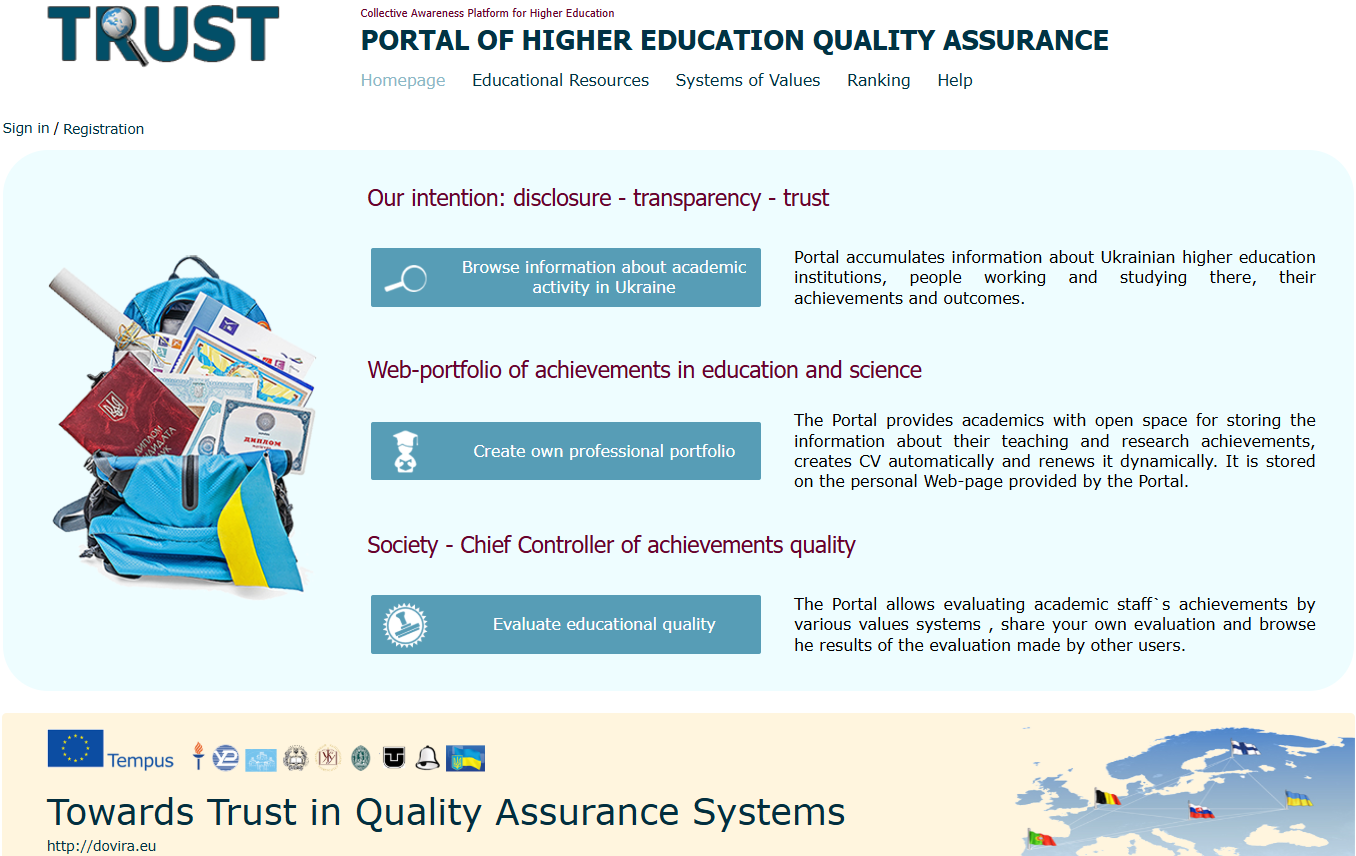
Portal TRUST as Collective Awareness Platform
From 2008 to 2015, the AI Department hosted the implementation of several national and EU-funded projects on Quality Assurance of Higher Education (QA of HE) supported by new ontology-based information technology. The main result is the National QA Portal built as a Collective Awareness Platform for transparent, unbiased reporting and evaluation of academic achievements with flexibly tailored systems of value.
The first portal prototype was developed under the support of the Tempus project “OntAc: Towards Transparent Ontology-Based Accreditation“, 2007 – 2008
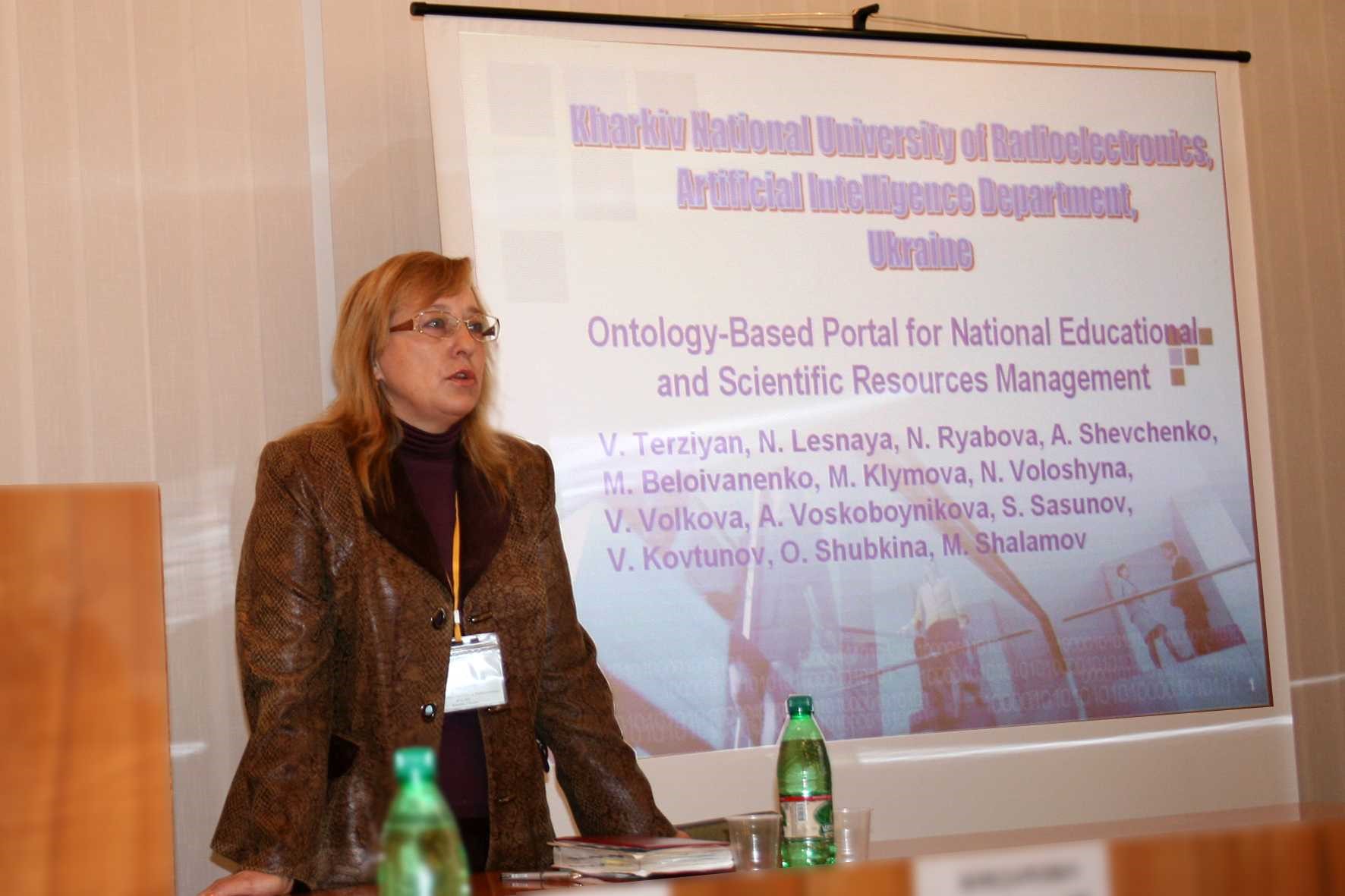
We developed and implemented a semantic technology for the creation of portals as platforms for transparent collaboration of multiple actors, accumulation and sharing of their information and quality assurance of their activity.
The technology is based on state-of-the-art solutions; it is universal and applicable to a wide range of domains and industries operating with numerous heterogeneous resources and requiring quality assurance of internal processes based on the evaluation of the resources.
Such Web portals’ architecture can become an implementation of the Collective Awareness Platforms (CAP) for integration of information, services, and infrastructure across a seamless and easy-to-navigate Web interface.
The first portal pilot was implemented for higher education.
It was supported by Tempus Project “TRUST: Towards Trust in Quality Assurance Systems”, 2011-2015. http://dovira.eu
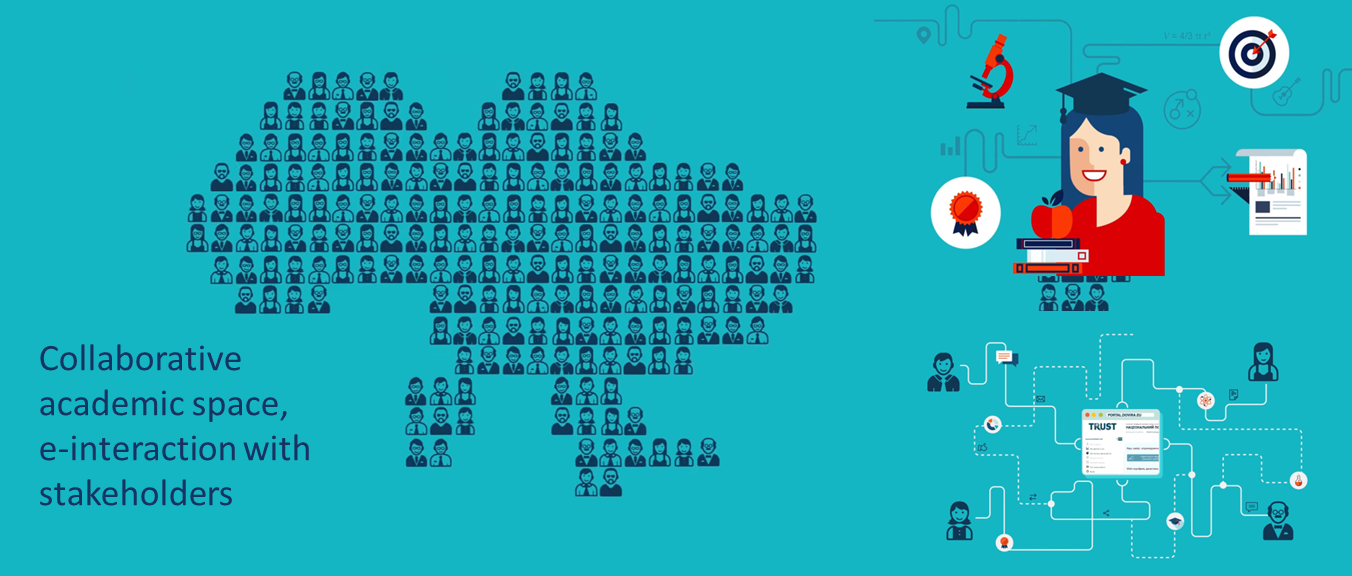
Semantic quality assurance portal for higher education (http://portal.dovira.eu/ and its English version http://portal.dovira.eu/en) is a platform for providing with information (knowledge) about Ukrainian higher education and its resources. The portal helps establish a higher quality of communication between various HE stakeholders by providing them a forum to contribute HE quality information and to perform quality monitoring collaboratively.
Portal provides a technical means for: composing, viewing and publishing ranks based on the facts registered in the Portal (personal achievements of the registered staff). Each ranking is performed on-the-fly from a user’s request. The Portal allows creating and applying different value systems in the form of flexible multidimensional and multicontextual HE-quality indicators weighted by their importance to the ranking query. Thus, each user can evaluate the relative quality of some HE resources from different points of view (representing, for instance, different stakeholders or different world-ranking systems). Portal allows registering and storing all types of higher educational resources and their proofs as well as generating dynamically user’s CV and personal Web-sites with user registered achievements.
The technical features of the Portal:
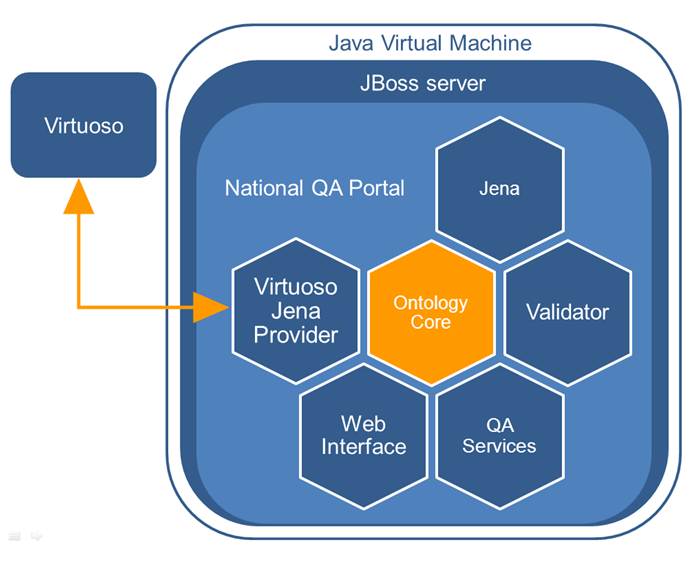
Portal operates by Java Virtual Machine which interacts with Virtuoso (Knowledge Base Repository).
Portal is built on the interaction of two independent ontologies: service and domain. Service ontology describes architecture and functionality of the Portal while domain ontology can describe any field or industry operating with numerous resources and requiring quality assurance of processes based on the resources` evaluation (higher education, medicine, business, industry, etc.).
About the portal opportunities implemented in support of the quality assurance system of higher education you can get know in popular form from the video https://youtu.be/FQ8r5MqDLs4 (in Ukrainian).
To get know the technical features of the portal organization in details, manuals on its use for both users and developers as well as other supporting materials can be found on the link http://portal.dovira.eu/Help.